Research

Understanding proteins through computation.

I connect molecular models, stochastic simulation, and structural data to study how proteins explore conformations and organize into functional assemblies.

Research directions

Questions that drive my work.

01Current research

How can we explore beyond one protein structure?

Geometric sampling methods for protein loops, fragments, and disordered regions, coupled to all-atom structural validation.

Protein conformational sampling
02Mechanistic modeling

What makes an assembly grow, stabilize, or remodel?

Mechanistic models linking molecular interactions and spatial organization to clathrin and HIV lattice dynamics.

Biomolecular self-assembly
03Scientific software

How do we make a method useful beyond one study?

Parallel simulation engines, automated model-building workflows, and consistent interfaces that other researchers can use.

Reusable computational methods
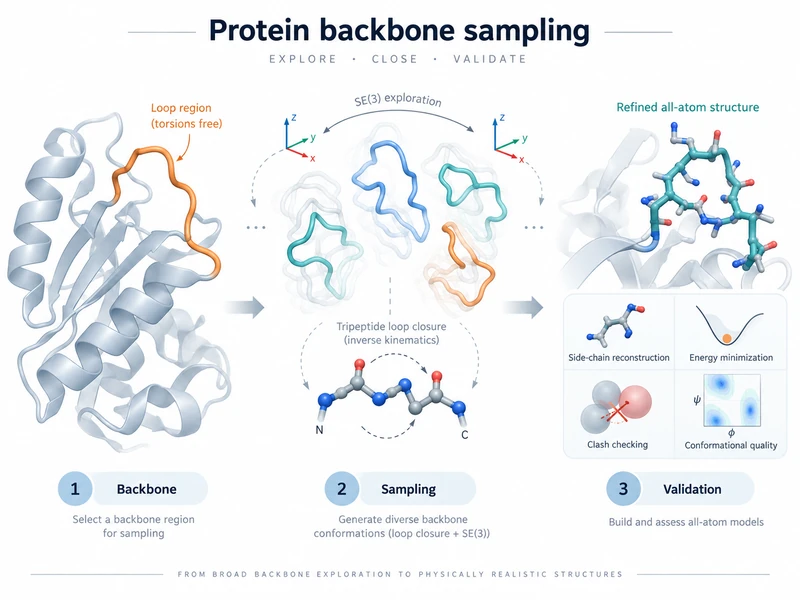
Protein backbone sampling: backbone selection, SE(3) exploration, inverse-kinematics loop closure, and all-atom validation.
Conceptual schematic

Molecular modeling · Ongoing research

Protein conformational sampling

Problem
Fixed-end loop closure limits exploration of fragments and disordered regions, whose endpoints need to move.
Built
Extensions to a C++ sampler (released-endpoint moves, spatial-hash clash detection) plus an OpenMM all-atom validation workflow.
Result
Broader exploration than tested generative samplers on the evaluated systems (ongoing work).
  • C++
  • Python
  • Protein sampling
  • OpenMM
Explore the work
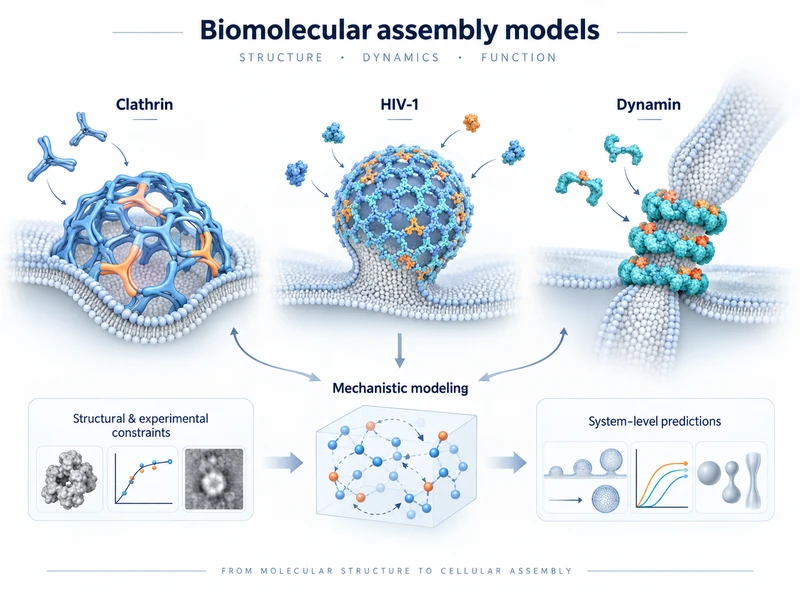
Biomolecular assembly models of clathrin, HIV-1, and dynamin, linking structural constraints to mechanistic models and system-level predictions.
Conceptual schematic

Computational biophysics · Published research

Biomolecular assembly models

Problem
Why do some molecular lattices stabilize while others fall apart or remodel?
Built
Stochastic reaction-diffusion models of clathrin and HIV Gag lattices.
Result
Reproduced experimental clathrin kinetics · identified an HIV binding-affinity range for stability and remodeling · first-author papers in PLOS Comp Biol and eLife, plus modeling for a Nature Communications study.
  • Stochastic simulation
  • Self-assembly
  • Membranes
  • Kinetics
Explore the work

Methods that support the science

Models need reliable computational tools.

NERDSS-MPI, ioNERDSS, and AutoCLIP connect simulation, automated model construction, and scientist-facing interfaces. Validation, testing, and documentation are part of the method—not an afterthought.

Explore the software

Research & collaboration

Let’s talk about the next question.

I’m interested in molecular-modeling methods, biomolecular simulation, and reusable scientific software.

sikaoguo@gmail.com