Molecular modeling
Exploring protein conformations beyond fixed-end loops
A modular C++/Python sampler for protein loops, fragments, and intrinsically disordered regions, paired with explicit all-atom validation.
At a glance
- Problem
- Fixed-end loop closure limits exploration of fragments and disordered regions, whose endpoints need to move.
- Built
- Extensions to a C++ sampler (released-endpoint moves, spatial-hash clash detection) plus an OpenMM all-atom validation workflow.
- Result
- Broader exploration than tested generative samplers on the evaluated systems (ongoing work).
The question
How can a loop-closure method explore protein segments whose endpoints are free to move?
Fixed-end loop closure addresses an important but constrained sampling problem. Exploring fragments and disordered regions requires one or both endpoints to move while maintaining feasible local backbone geometry.
My work extends the geometric sampling machinery and separates conformational exploration from downstream evaluation of structural quality.
The approach
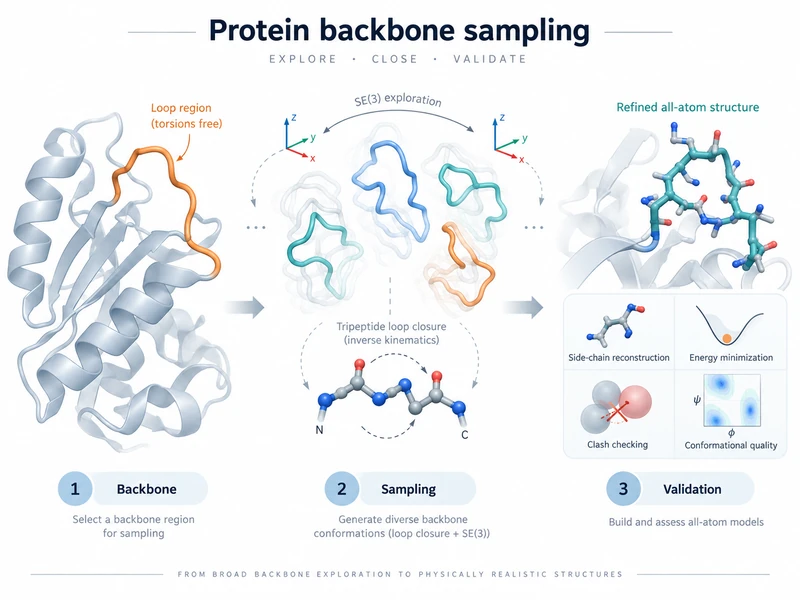
- 01
Extend the sampler
Support fixed or independently released endpoints, multiple loops, and rigid secondary-structure motion.
- 02
Propose conformations
Combine geometric endpoint moves with residue-specific Ramachandran priors and spatial-hash clash detection.
- 03
Validate structures
Reconstruct side chains, minimize with OpenMM, and assess conformational quality and ensemble diversity.
What I developed
- Implemented released-anchor SE(3) proposals and multiple sampling frames.
- Engineered spatial-hash collision detection and dense/sparse memory backends.
- Integrated AttnPacker, OpenMM, and PhiSiCal-Checkup in a reproducible validation workflow.
- Resolved stability and zero-output failure modes in the sampling software.
Results & validation
- Controlled comparisons with tested generative samplers showed broader exploration on the evaluated systems. This is a system-specific observation, not a claim of general superiority.
- Ongoing work: no unpublished manuscript figures, raw benchmark data, or unfinished software releases are distributed here.
This project is ongoing. Comparisons are limited to the evaluated systems; no general superiority claim is implied.
Research & collaboration
Let’s talk about the next question.
I’m interested in molecular-modeling methods, biomolecular simulation, and reusable scientific software.