2022
Computational biophysics
Linking molecular interactions to assembly and remodeling
Mechanistic models of clathrin and HIV lattices that connect molecular interactions to experimentally observed assembly behavior.
At a glance
- Problem
- Why do some molecular lattices stabilize while others fall apart or remodel?
- Built
- Stochastic reaction-diffusion models of clathrin and HIV Gag lattices.
- Result
- Reproduced experimental clathrin kinetics · identified an HIV binding-affinity range for stability and remodeling · first-author papers in PLOS Comp Biol and eLife, plus modeling for a Nature Communications study.
The question
What determines whether a molecular assembly stabilizes, disassembles, or remodels?
Molecular structures alone do not describe how assemblies emerge over time. My models combine structural information with stochastic simulation, kinetic measurements, and interaction constraints.
The goal is to connect microscopic interaction rules to experimentally interpretable assembly behavior rather than reproduce a single structural snapshot.
The approach
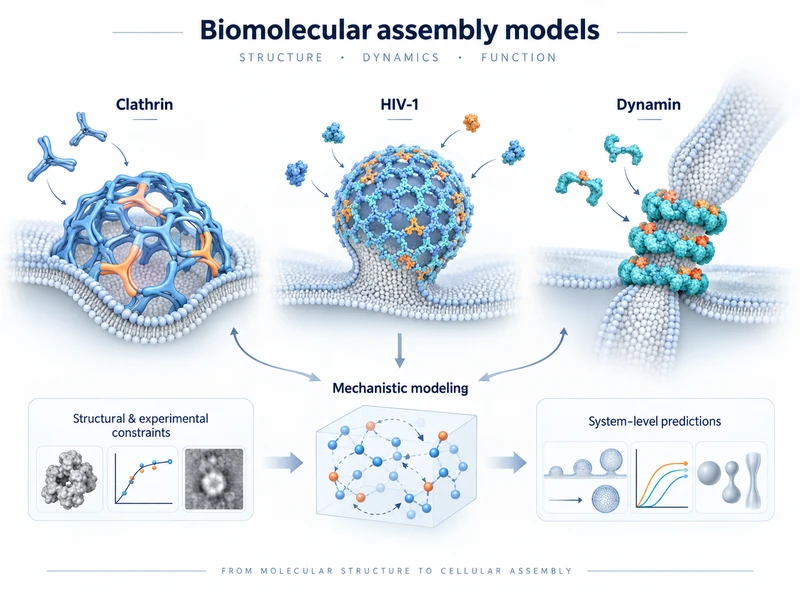
- 01
Define molecular interactions
Build structure-resolved models with explicit interaction affinities, concentrations, and membrane geometry.
- 02
Simulate assembly dynamics
Study association, dissociation, nucleation, and remodeling using stochastic reaction-diffusion models.
- 03
Connect to experiments
Compare kinetics and timescales with experiments and identify mechanistic explanations.
What I developed
- Modeled clathrin self-assembly and reproduced experimental kinetics.
- Explained why adaptor-poor clathrin lattices fail to stabilize.
- Identified a binding-affinity range compatible with both HIV Gag/Gag-Pol lattice stability and remodeling.
- Contributed quantitative modeling to collaborative work on dynamin recruitment and membrane nanoclusters.
Results & validation
- First-author clathrin work published in PLOS Computational Biology (2022).
- First-author HIV lattice work published in eLife (2023), with remodeling on experimentally observed viral-maturation timescales.
- Collaborative dynamin work published in Nature Communications (2024).
Related publications
Research & collaboration
Let’s talk about the next question.
I’m interested in molecular-modeling methods, biomolecular simulation, and reusable scientific software.