Research portfolio

Methods, mechanisms, and reusable tools.

Selected projects in protein conformational sampling, biomolecular self-assembly, and scientific software.

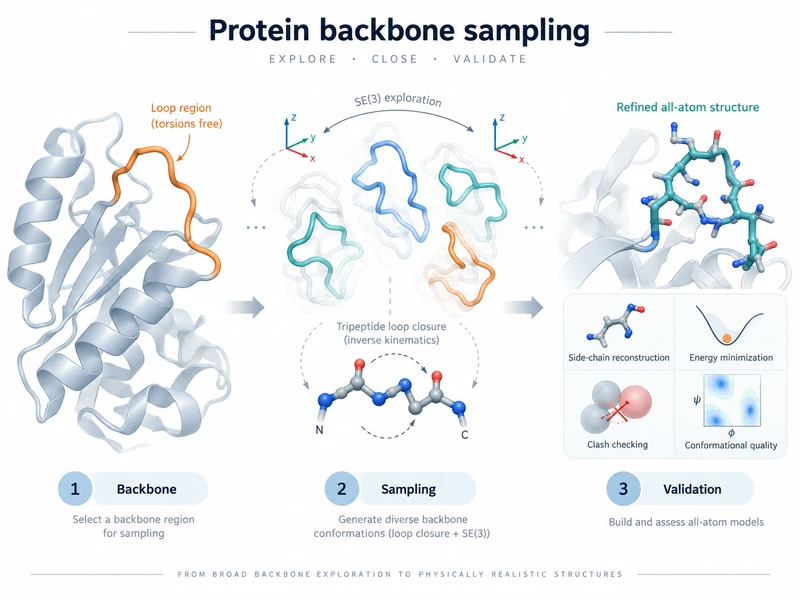
Protein backbone sampling: backbone selection, SE(3) exploration, inverse-kinematics loop closure, and all-atom validation.
Conceptual schematic

Molecular modeling · Ongoing research

Protein conformational sampling

Problem
Fixed-end loop closure limits exploration of fragments and disordered regions, whose endpoints need to move.
Built
Extensions to a C++ sampler (released-endpoint moves, spatial-hash clash detection) plus an OpenMM all-atom validation workflow.
Result
Broader exploration than tested generative samplers on the evaluated systems (ongoing work).
  • C++
  • Python
  • Protein sampling
  • OpenMM
Explore the work
NERDSS and ioNERDSS workflow from PDB/mmCIF structures through coarse-grained models and reaction rules to parallel simulation.
Conceptual schematic

Scientific computing · Open source

NERDSS + ioNERDSS

Problem
Building simulation models from molecular structures needed automation, and particle-based simulation needed to scale beyond a single process.
Built
C++/MPI spatial domain decomposition for NERDSS and automated structure-to-model Python workflows in ioNERDSS (co-developed).
Result
≈90× speedup on 96 CPUs (20,000-particle benchmark) · 44,000+ structures benchmarked · validated across 7 benchmark models.
  • C++
  • Python
  • MPI
  • HPC
Explore the work
AutoCLIP workflow from CLI metadata and interface design to a validated JSON specification and VMD, PyMOL, and web applications.
Conceptual schematic

Research software · Open source

AutoCLIP

Problem
Each scientific tool needed a separate implementation for PyMOL, VMD, and the web.
Built
A specification-driven Python framework with JSON Schema validation, platform generators, and Linux/macOS CI.
Result
9 structural-biology tools deployed across 3 platforms, one specification each.
  • Python
  • JSON Schema
  • PyMOL
  • VMD
  • Web
Explore the work
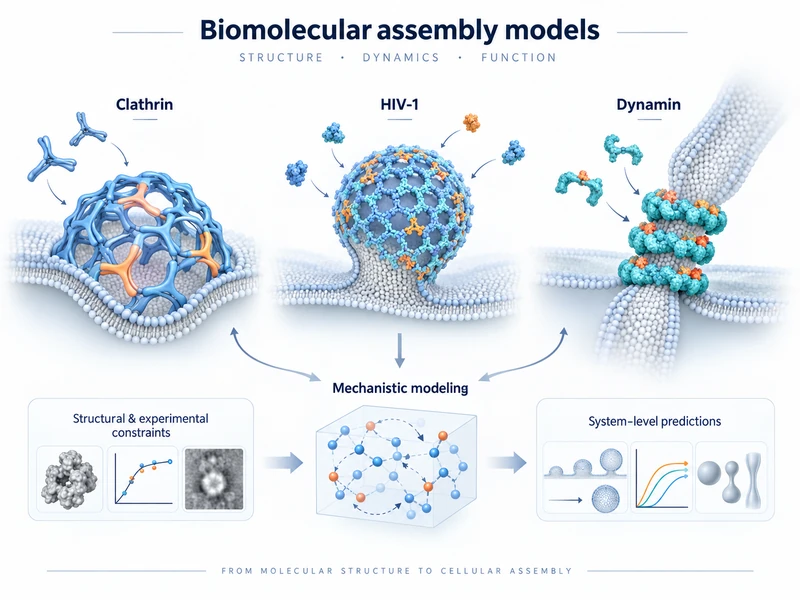
Biomolecular assembly models of clathrin, HIV-1, and dynamin, linking structural constraints to mechanistic models and system-level predictions.
Conceptual schematic

Computational biophysics · Published research

Biomolecular assembly models

Problem
Why do some molecular lattices stabilize while others fall apart or remodel?
Built
Stochastic reaction-diffusion models of clathrin and HIV Gag lattices.
Result
Reproduced experimental clathrin kinetics · identified an HIV binding-affinity range for stability and remodeling · first-author papers in PLOS Comp Biol and eLife, plus modeling for a Nature Communications study.
  • Stochastic simulation
  • Self-assembly
  • Membranes
  • Kinetics
Explore the work

Research & collaboration

Let’s talk about the next question.

I’m interested in molecular-modeling methods, biomolecular simulation, and reusable scientific software.

sikaoguo@gmail.com